Constraint-Aware Terrain Generation
IEEE CoG 2026, oral. 89 of 239 papers (37%) accepted
Publication
IEEE Conference on Games 2026 (CoG), Madrid
Petr Šimůnek, Oliver Wakeford · 2026
Full paper, oral. Presented by Petr Šimůnek.
Built with
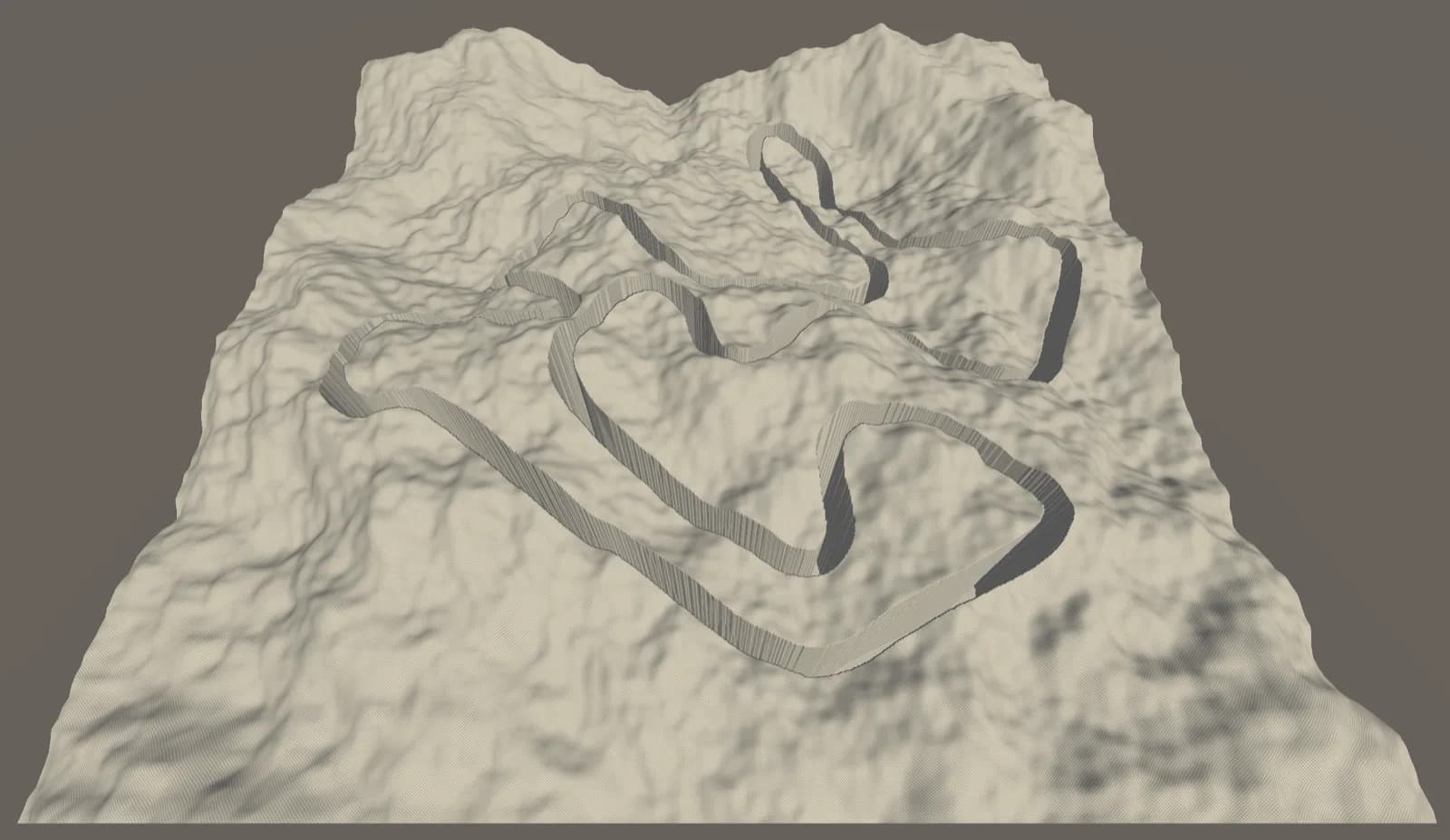
Game levels are often built half by hand. A designer fixes the parts that matter, say a road or a race-track corridor, and the rest of the heightmap gets filled in automatically. The fixed heights have to stay exact, and the join between fixed and generated ground shouldn't show.
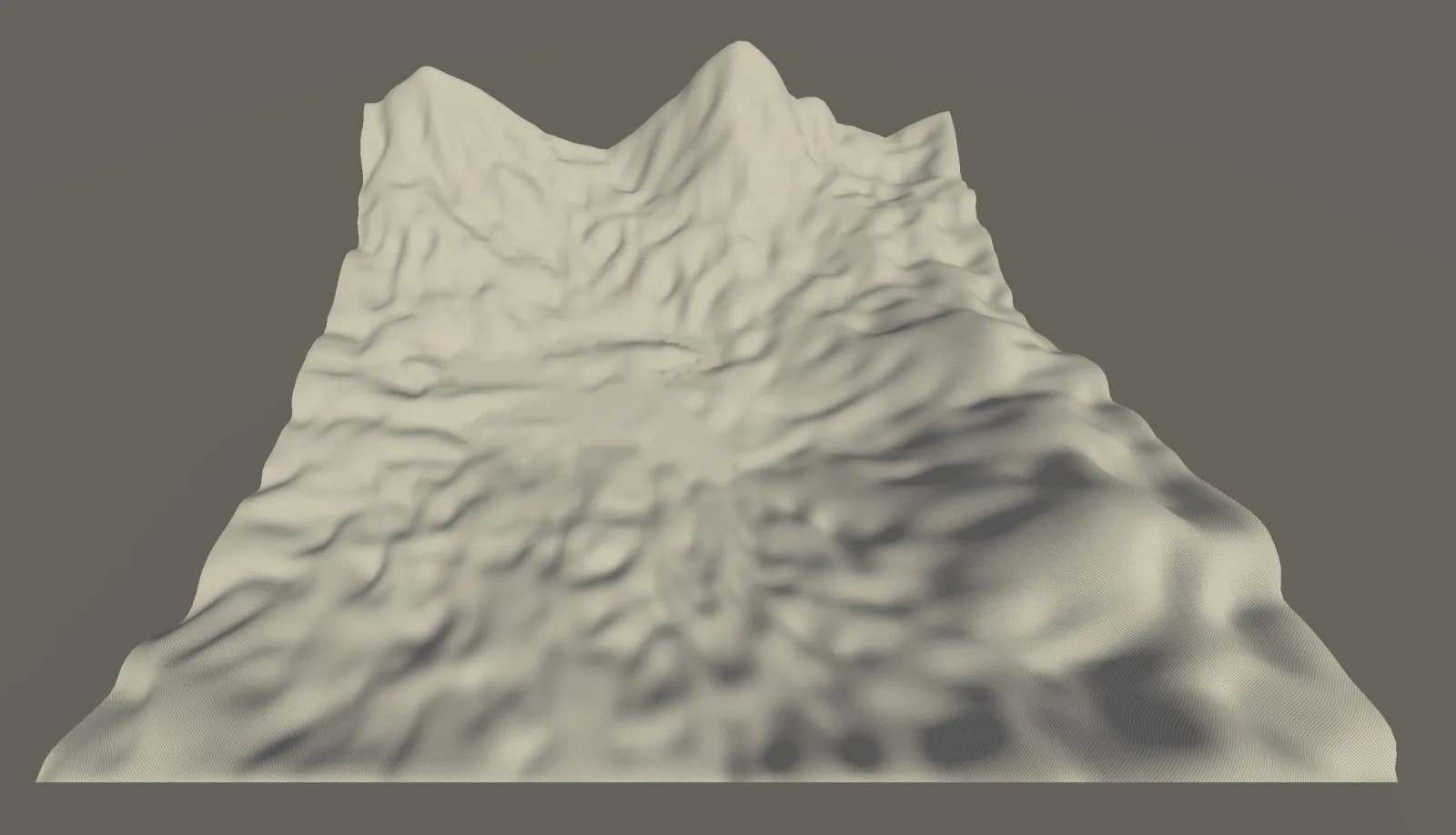
That join was my bachelor's thesis at Charles University, a terrain tool built for the game Engine Evolution. I wrote it as a Unity component. It first generates terrain in the free cells with noise, then blends it into the fixed ones. A breadth-first search gives every free cell its distance to the nearest fixed cell, and smoothing and height scaling are weighted by that distance, so the blend is strong at the seam and fades out further away. The slow steps, smoothing and erosion, run on the GPU as compute shaders.
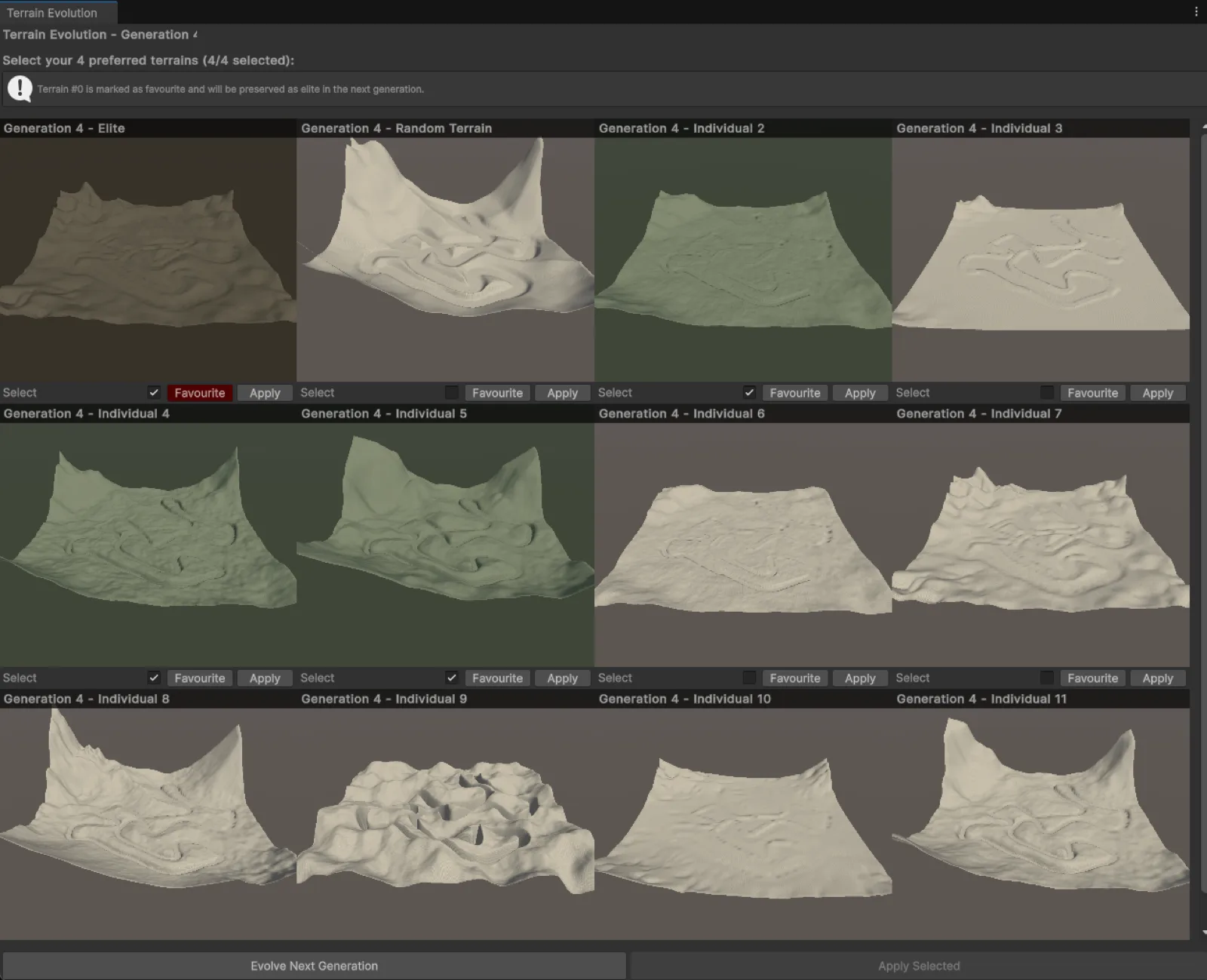
The tool ended up with a lot of parameters, and tuning them by hand was slow. So I added an interactive genetic algorithm. It shows you a grid of terrains, you pick the ones you like, and it breeds the next generation from those. The thesis was graded 1 (Excellent), and I defended it in September 2025.
My supervisor, Petr Šimůnek, then took it further, and he's first author. The paper's version propagates upper and lower height envelopes out from the fixed cells using slope-weighted path costs. It fills the space between them with a smooth base layer plus bounded detail, then clamps to the envelopes, which is what keeps the fixed heights exact.
On the paper's benchmark it had the lowest mean-height bias of the methods tested, which measures how far the filled terrain drifts up or down overall. That came out about 81% lower than the blurred base used in production (0.01346 against 0.07112). It runs 2.1× to 23.9× faster than the harmonic baseline, though it's still a bit slower than the plain blur. The list at the bottom covers where it falls short.
It's a full paper at IEEE CoG 2026 in Madrid, presented as an oral by Petr. The proceedings aren't online yet, so the links go to the thesis and the code.
Before / after
What this does not show
- Second author. My supervisor extended the thesis method into the paper, ran the experiments and led the writing. The benchmark numbers here come from his experiments.
- The bias reduction is against the blurred base. Inverse distance weighting, a much simpler method, is within about 0.4% on the same metric.
- No better than simpler baselines at following the slope preferences, and total variation is worse than the harmonic baseline (933.5, against 480.9 for the harmonic baseline), so the surface is rougher.
- It runs 1.4 to 1.8 times slower than the blur it improves on, depending on resolution.
- The random detail step measured zero diversity, so repeated runs gave the same terrain. A reviewer raised it, and it's fair.
- One authored benchmark scenario, and no ablation study.
- The thesis results were judged by eye, by me, against visual criteria I set, plus timings. No quantitative metric.